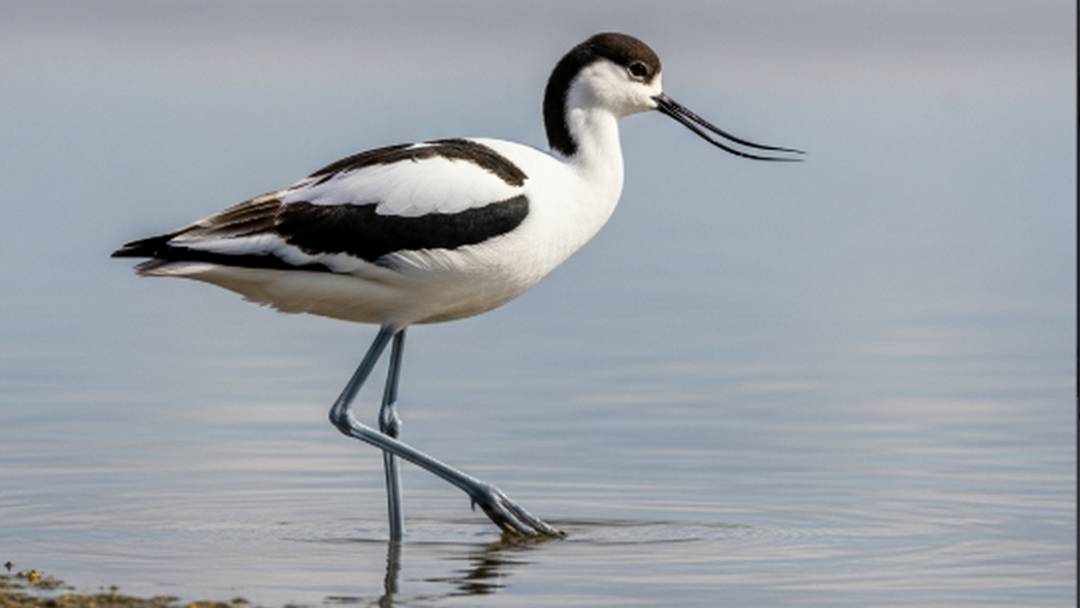
The Pied Avocet, a wader with a graceful silhouette.
Introduction
The Pied Avocet (Recurvirostra avosetta) is a medium to large-sized wader, famous for its distinctive silhouette and bicolored plumage. Belonging to the Recurvirostridae family, it is uniquely recognizable by its long, slender, and upturned bill.
Length: 42 to 45 cm (16.5 to 17.7 inches)
Wingspan: 67 to 80 cm (26.4 to 31.5 inches)
Weight: 220 to 400 grams (7.8 to 14.1 ounces)
Its elegant appearance is accentuated by its very long, blue-grey legs. It is a freshwater and brackish water bird that lives in wetland areas, feeding by sweeping its curved bill through water or mud.
Our Ornithologist's Advice
By the Les-Oiseaux.com team, published August 1st, 2025.
My personal advice: The Pied Avocet is a spectacle to observe in wetlands. Its appearance is so unique that it is rarely confused. To fully appreciate it:
The upturned bill: This is its most striking feature. Observe how it uses it by sweeping laterally across the surface of the water or mud to catch small invertebrates. This movement is mesmerizing and distinctive.
Silhouette and plumage: Its brilliant white plumage with crisp black markings on the head, nape, and wings, combined with its long, slender blue-grey legs, gives it an unparalleled elegance. In flight, these patterns are particularly highlighted.
These details, combined with its quick and graceful gait in shallow water, will help you distinguish and admire this majestic bird of coastlines and marshes.
Have you observed the Pied Avocet?
Share your experience and photos! Your observations enrich the Les-Oiseaux.com community.
You can share as a guest or create an account to track your contributions.
Identification
Identifying the Pied Avocet is undoubtedly one of the easiest among waders due to its unique characteristics.
Adult plumage: The body is predominantly pure white, with distinctive black markings. The crown, nape, and part of the back of the neck are black. The wings feature black bands: three longitudinal ones on the scapulars, wing coverts, and primary flight feathers, particularly visible in flight. The legs are very long, slender, and pale blue-grey, with webbed feet, which is quite rare for a shorebird. The bill is black, very slender, and strongly upturned. There is no significant seasonal variation in plumage.
Juvenile: The young Pied Avocet has less contrasting plumage. Its black parts are tinged with brownish, and the white upperparts may show sepia, buff, or grey-brown spots. The bill of juveniles gradually curves with age.
The black and white patterns of the Pied Avocet are very visible in flight.
Dimensions and Scientific Records (Pied Avocet)
Characteristic
Male
Female
Record / Average
Length
42 – 45 cm
42 – 45 cm
42 – 45 cm (adults)
Weight
220 – 400 g
220 – 400 g
220 – 400 g (adults, average 325 g)
Wingspan
67 – 80 cm
67 – 80 cm
67 – 80 cm
Flight speed
Fast
Fast
Direct and fast flight
Life expectancy
Up to 27 years
Up to 27 years
Approximately 20-25 years (record 27 years)
These figures confirm the Pied Avocet as a significant-sized wader, adapted to life in wetlands.
The Black-winged Stilt (Himantopus himantopus) is another black and white wader, with extremely long pink legs. The main difference is its bill: the Black-winged Stilt's bill is straight, slender, and black, unlike the upturned bill of the Pied Avocet. Its body is also smaller (33-36 cm) than that of the avocet. Nesting colonies can sometimes be mixed.
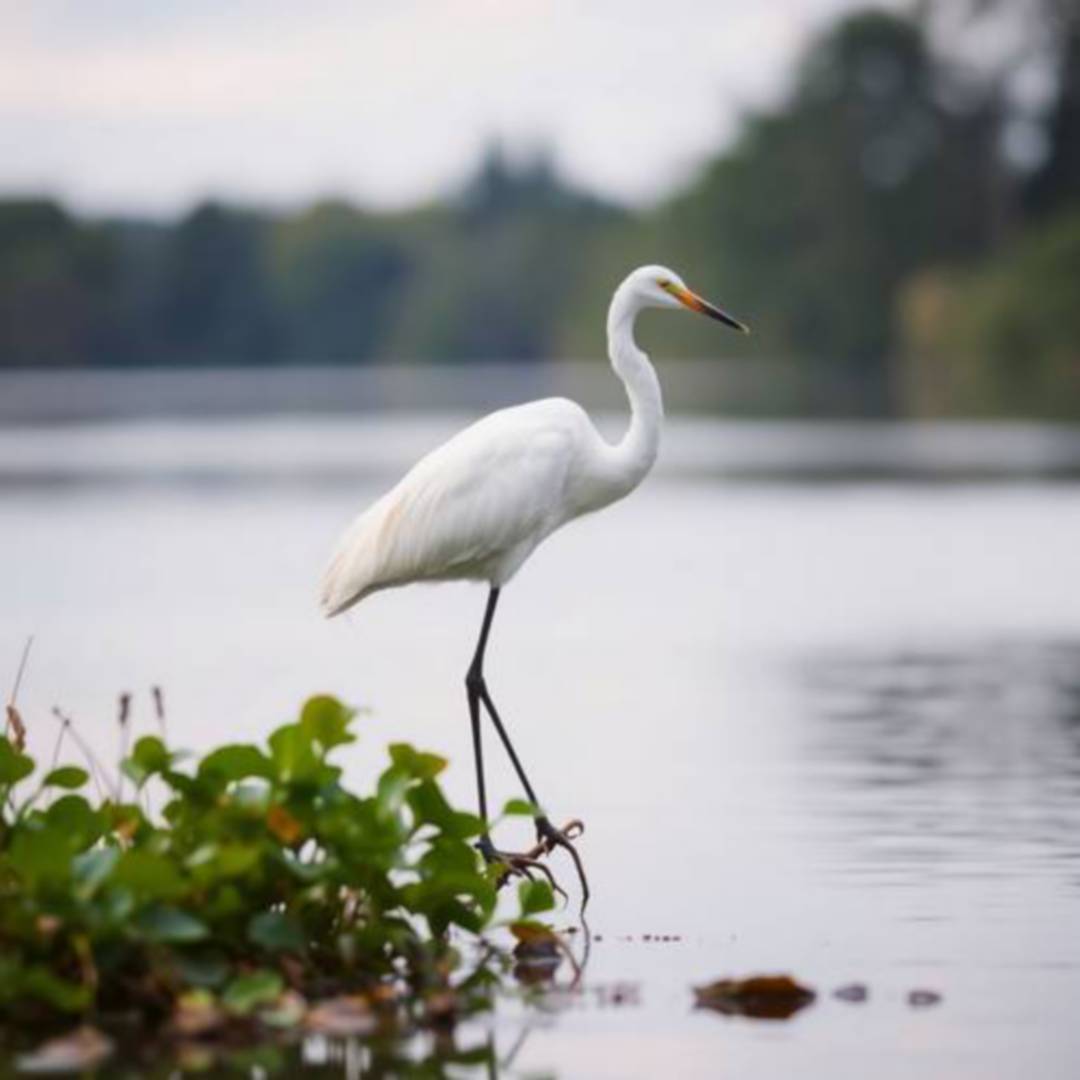
The Little Egret (Egretta garzetta) is entirely white, with a long, straight, tapered black bill and black legs with yellow feet. Although similar in size or slightly larger (55-65 cm) and living in wetlands, its uniform color and bill shape clearly distinguish it from the Pied Avocet.
The bird emits a characteristic vocal repertoire, particularly audible during the breeding season or when alarmed. Its calls are often described as nervous, sonorous yapping sounds, such as "kluit" or "klip." It can also produce clear, melodious "kluiit" calls. In case of threat or concern, the call becomes higher pitched, resembling "kloo-eet" or a shrill "krrreee-yu." The French name retained the avocet's elegance rather than its bill shape, unlike the Dutch name "Kluut" which is an onomatopoeia of its most frequent call.
0:00 / 0:00
Habitat and Distribution of the Pied Avocet
The Pied Avocet is a wader species that favors open, shallow aquatic environments, whether saline or brackish. It is characteristic of coastal lagoons, estuaries, mudflats, salt marshes, and occasionally freshwater lakes or slow-flowing rivers. The presence of these habitats is crucial for its nesting and foraging.
The species is widely distributed from Western Europe to the plains of Central Asia, through the Indian subcontinent, and Africa. It is a partial migrant, with populations undertaking long journeys south to winter in Southern Europe, North and West Africa, the Middle East, and Asia. Other populations are sedentary.
Distribution Map
Present year-round (Resident)
Breeding Range
Wintering Range (Non-breeding)
Passage Area (Migration)
Diet
This species primarily feeds on small benthic aquatic invertebrates, which it finds in shallow water and mud. Its diet includes annelids (oligochaete and polychaete worms), small crustaceans (such as the genus Corophium), bivalve molluscs, as well as larvae and small insects (such as midges and beetles) measuring between 4 and 15 millimeters long.
It uses its upturned bill in a very characteristic way: by plunging it open into the water or mud, it sweeps it laterally from right to left, stirring up the mud to bring prey to the surface, which it then captures. It can also probe the mud with its bill.
Reproduction
Pied Avocets typically nest in colonies, ranging from 10 to 70 pairs, on islets or dikes immediately adjacent to water. They are considered philopatric, meaning they tend to return to their birthplace to breed.
The breeding season extends from April to August in Eurasia. The nest is a simple scrape on the ground, often lined with vegetation and located in short grass or on a sandbank near the water. The female lays an average of 3 to 4 eggs, which are beige and often speckled. Incubation lasts approximately 23 to 25 days and is shared by both parents.
The chicks are precocial, meaning they leave the nest very quickly after hatching to hide in surrounding vegetation and begin foraging. They are able to fly and become independent between 35 and 42 days after hatching. Adults protect them from bad weather and predators like the Black Kite. They also share nesting sites with other species, such as the Black-winged Stilt.
Conservation Status
The Pied Avocet is classified as "Least Concern" (LC) by the IUCN (International Union for Conservation of Nature). Its global population is considered relatively large, and its range is very extensive.
However, the species is sensitive to several anthropogenic threats. These include habitat destruction (particularly the transformation of lagoons and salt marshes), pollution, insecticides, infrastructure development, and human disturbance at nesting sites. Botulism and avian influenza can also affect populations. In France, the species is protected.
Frequently Asked Questions (FAQ)
How to identify the Pied Avocet?
The Pied Avocet is easily recognizable by its contrasting black and white plumage, very long blue-grey legs, and especially its slender, black, upturned bill.
Where does the Pied Avocet live?
It frequents shallow wetland areas such as coastal lagoons, estuaries, mudflats, and salt marshes. It can be found across much of Europe, Asia, and Africa.
What does the Pied Avocet eat?
It is a carnivorous bird that feeds primarily on small aquatic invertebrates, crustaceans, worms, and larvae. It catches them by probing the water or mud with its characteristic bill, often using a sweeping motion.